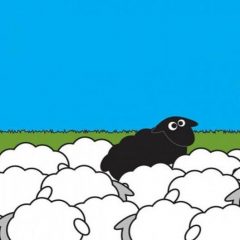
small things you can do to change your perspective that don’t cost the planet

inspired by Keri Smith

(an ongoing list)

1. Change the height at which you perform everyday tasks. (i.e. brush your teeth while on your knees.)

2. Look under every object you encounter for a week.

3. Wear sunglasses all day (inside and outside). Notice how it feels to take them off.

4. Alter your body somehow so as to impede your motor function slightly. i.e. tie two fingers together.

5. For one day greet everyone you encounter with “top o’ the morning to ya!”

6. Speak through a tube (paper towel tube, then recycle it when you’re done).

7. Move frequently used items (i.e. salt and pepper shakers) to places they are not normally found.

8. Place something small behind your ear for an entire day. See if you forget about it.

9. Cut your food into new and interesting shapes. Arrange your dinner (or your table items) into a “grid” formation.

10. Exclude one vowel from all of your emails.

11. For one month create all of your correspondence on an outdated form of technology. (i.e. typewriter, pen & paper, dictaphone).

12. Add something to your name. (“the 3rd”, “the great”, “the illustrious”) Alternate: Add some letters to your name but don’t tell anyone.

13. Sponsor a contest based on an everyday task. (i.e. “Contest for person whose socks stay up consistently”)

Now to muster up the courage to do at least one of them (without getting fired!)

Creepy Critters


Halloween is a holiday with lots of creepy wildlife associated with it, but are they really so creepy? From toads to bats to owls, the National Wildlife Federation shares the facts about these animals and what they are up to at this time of year, which might dispel a few myths.

Bats


Blood sucking vampire bats are real – but they mostly feed on chickens and cows and only live in Latin America. Most North American bats are insect eaters, feeding on everything from moths to mosquitoes to beetles. They use echolocation to find their prey, which is kind of like radar, rather than eyesight. They tend to have beady little eyes and weird-shaped faces which makes them look scary. But those faces help capture sound waves bouncing off of prey and other objects and funnel those waves to their ears.

Many bat species are entering into hibernation in caves or hollow trees, but some fly south for the winter just like birds.

Spiders

Spiders, with their eight legs and multiple eyes, are creatures right out of nightmares—and their sticky webs and venomous fangs don’t help their public image either. But even though they might look scary, spiders are actually extremely beneficial predators of all sorts of insect pests. And only three species in the U.S. that have venom considered strong enough to hurt people: the black widow, the brown recluse and the hobo, and spider bites from these are very rare.

In the fall, female spiders are guarding egg sacks which hold the next generation of spiders.

Toads


Toads are not just a key ingredient in witches’ brew, they are important environmental indicators. All amphibians are susceptible to environmental toxins because of their sensitive skin. They are usually the first species to die out in polluted areas. If you have healthy toad populations in your area, it’s a good sign that your neighborhood is fairly unpolluted. And no, you cannot catch warts from touching a toad.

Toads are voracious pest predators in the warm months, but go into underground hibernation by late fall and won’t emerge until spring. Click here for fun toad and frog facts!

Wolves

The howl of the wolf can cause either heart-rending terror or spiritual inspiration. People have either vilified or glorified wolves throughout history, but the real life wild canines are neither hounds from hell or spiritual guides. In reality, gray wolves are top predators that play a key role in balancing the ecosystem. They control deer and other prey populations as well as other predators lower down on the food chain, like coyotes and raccoons.

Once found throughout North America, the only remaining gray wolf populations live in limited regions of the United States and Canada in wilderness areas. They go out of their way to avoid humans. At this time of year, they are in the process of growing their thick winter coats to guard against winter’s bitter temperatures.

Snakes


The slithering, legless body. The forked tongue. The lidless eyes. Everything about a snake is decidedly non-human. But even though they strike fear in many people, most snake species are completely harmless. In fact, snakes are enormously beneficial, helping to control insect and rodent pests. The only time a snake will try to bite is if it’s cornered or startled. The natural reaction of all snakes to people is to get away or hide.

By late October, most snakes are moving to their underground hibernation grounds, where they will doze away the cold months waiting for the warmer days of spring.

Owls

The nocturnal habits, glowing eyes and utterly silent flight make these predatory birds the epitome of eeriness. It turns out that all of those things are simply adaptations for survival. Owls are nocturnal to avoid competition for prey with day-flying hawks. Their giant eyes and the fringed feathers that make no noise when the bird is flying allow them to hunt in the darkness.


Most owls are year-round residents and don’t migrate. Listen for the hoot-hoot-hoot of the great horned owl or the whinnying shriek of the screech owl when you’re trick or treating this year!

Now that you know the truth about these valuable wildlife, get outside and look for these cool animals.You might consider attracting them to your yard (except the wolves) The National Wildlife Federation shows you how to turn your property into a wildlife habitat at http://www.nwf.org/gardenforwildlife

© 2008 Newswise

Food Baby

The other day I was out for lunch with my significant other (S.O.) and his mother, who was visiting from France. We went to a mom-and-pop sandwich place we frequent often, so we are on friendly terms with the owner who works behind the counter. 
 

While waiting for our orders, S.O., his mother and I were comparing tans on our forearms. We were looking down, pointing and laughing since we weren’t very dark and just looked like we weren’t anemic anymore. The owner noticed our conversation and said, “Do I see something changing?” while looking down at my stomach. At first I thought she was asking about my “tan,” but then I realized what she meant and responded with a stern “Oh no! Not at all!” while waving my hands downward. Then S.O. said loudly while patting my belly, “No, it’s just all the rich French food she’s been eating lately!” laughing, thinking he was just oh-so-clever and funny, as if he saved the awkward moment when really he just made it much worse. I looked down, clutching my stomach and felt myself blushing. I laughed politely while dying inside as we left the restaurant.
 
Just after we walked out, his mother said, “Well, that woman obviously doesn’t keep up on the latest fashions!” The top I was wearing had a band just below the bust line but it wasn’t loose and flowing like a maternity top. I had just bought it  from the “new arrivals” rack at Naf-Naf, a trendy clothing store in the heart of Paris, so I was really miffed that it might make me look  pregnant. I asked S.O., who gave me this I-feel-sorry-for-you look and said, “Well, actually ….” 
 
The argument that followed that comment can be found in his memoir, “How to Avoid Living in the Dog House.” My point of this story is how some people are so focused on baby-making, that any sign of body fat equals pregnancy. This usually leads to embarrassment of both parties. People should only ask that question if it’s terribly obvious. I don’t know this restaurant-owner very well, our relationship is strictly customer-based, so I thought it was quite inappropriate for her to comment like that. If I really were pregnant, I would choose to offer that information to her and not leave it up to her to assume on any given day.

That wasn’t the first time the outspoken restaurant owner asked this type of question. She has asked me in roundabout ways several times before. She’s also not the only person to do so. We have quite a few friends and family with small children, so I get a lot of, “So, when are you having kids?” When I gain a little weight and they jump with excitement because people think I am  WITH child. I have to inform them, “Nope, just WITH Cheeseburger!” When I say I’m nauseous, they say, “Are you sure you’re not pregnant?”  Maybe I just don’t feel good.  Response to that, “Oh, you never know!” rather than, “Oh, I’m sorry, are you okay?” 

My S.O. and I fall into the non-breeding category. We are child free by choice. This is a concept many people cannot grasp. When I tell people I am not having children they give me a sad look as if my child-to-be had lived and died, and  say, “You can always adopt” or “Nancy from choir is 47 and has a five year old!” Good for her, but it’s not for me.  It’s not that I can’t have them, I don’t want to have them. I’m all for everyone else having them, don’t get me wrong. Have as many as you like. I just don’t want to be the one giving birth.  And then I get the old, “Oh, you’re the type of person who will regret not having kids.” and “Having kids was the best thing I ever did. I don’t know how I’d live without them!” Again, your story, not mine.

Just FYI, I am not a fat person. I am 5’9″ and weigh 140 pounds – see? I am not ashamed of my weight. 
I am not in shape and have a  few love handles, but what 30 plus person doesn’t ? Just anorexics or the rare naturally thin folks that everyone loves to hate.

 
I joke around with my friends now that I’m expecting a “food baby” any time now. I will give myself nine months to exercise it out. Who knows, maybe I’ll have another, and call him my little Pizza Pops. Maybe I’ll have non-identical twins, Cheesecake and Potato Chips!

Not to Breed

These links are taken from the website Childfree.net to learn how to cope with the idiotic questions and comments we get from the conservative mainstream: 

You’re Being Selfish  http://www.childfree.net/potpourri_selfish.html

Preparation for Parenthood http://www.childfree.net/potpourri_prep.html

This one is from Ann Lander’s Childless Couple – very witty http://www.childfree.net/potpourri_annlanders.html

Why is it so important for you to have a baby? http://www.childfree.net/potpourri_whybaby.html

How Childless couples get the short end of the stick when it comes to benefits http://www.childfree.net/potpourri_lift.html

Couples in no-kid marriages happiest http://www.childfree.net/potpourri_couples.html

Celebrity/Notable Child-Frees http://www.childfree.net/potpourri_celebrity.html

Clean Up Your Act *


* A clean home is a healthy home, right? Not necessarily. It turns out the very efforts to rid your living pace  of dirt, dust, mildew and grime might make it a more dangerous environment for you and your family. And you’re not the only ones who could suffer: Many of the ingredients in household cleaners contaminate the air and water as well as thousands of organisms, from algae to wildlife, when they are washed down drains and make their way into the ecosystem.

WHAT’S WRONG WITH WHAT’S ON THE MARKET
“Conventional commercial cleaners are some of the most toxic substances you can bring into our home,” says Linda Mason Hunter, home ecology specialist and co-author of Green Clean: The Environmentally Sound Guide to Cleaning Your Home. “Many of the chemicals found in cleaners have only been around since World War II, and they’ve never been tested for long-term health effects.”

The Environmental Protection Agency (EPA) has found that the immediate health risks associated with the use of conventional household cleaning products include asthma attacks, headaches, dizziness, visual disorders and memory impairment. Additionally, a 1987 study by the EPA determined that the air inside a typical home is up to ten times more polluted than the air outside the home because of the toxic chemicals many of us use to scrub and sanitize. They include the following:

  • Formaldehyde a volatile organic compound, found in liquid cleaners and floor polishes, that is suspected of causing cancer.
  • Chlorine bleach (sodium hypochlorite) a toxic compound that irritates the respiratory system and emits poisonous vapors when combined with ammonia or vinegar.
  • Petroleum distillates (naphthas) nonrenewable, oil-based resources found in furniture and floor polishes that can affect the central nervous system and lead to cognitive and behavioral problems.
  • Pesticides and fungicides such as chlorine and alkyl ammonium chlorides, found in most conventional antibacterial cleaners and mildew removers. They can cause skin irritation and nervous system damage.

POLISH OFF OR PITCH OUT?
There are two ways to go about switching over to eco-friendly products: gradually replace your scrubs and sprays as you use them up, or toss toxin-filled items out once and for all. Experts are split on the issue, but Annie Berthold-Bond, author of Clean & Green: The Complete Guide to Non-Toxic and Environmentally Safe Housekeeping, cautions that there are a few situations in which she suggests making an immediate change. “If the home contains young children or anyone who is pregnant, sick or sensitive to chemicals, contact your local recycling center about disposing of your toxic cleaning products,” she recommends.

If you choose to deplete your supply of conventional household cleaners before replacing them with safer alternatives, carefully follow the instructions to avoid toxic reactions, always wear gloves when you clean, and make sure your home has lots of ventilation while you’re scrubbing—even an open window or two can help get the fumes out.

MAKE A LIFELONG CHANGE
Once you start using natural cleaning agents, you’ll find it hard to believe you ever allowed something labeled “Hazardous” into your house. Here are a few of the products we’ve taken a shine to, plus some tried-and-true homemade options you can make with everyday pantry items such as baking soda and vinegar. Store-bought or homemade, they’re all reasonably priced, readily available and really work at keeping things spotlessly clean—without compromising your health or the environment.

AMAZING ALL-PURPOSE LIQUIDS
Earth Friendly Products’ Creamy Cleanser
Who wouldn’t choose lovely scented lemon oil over petroleum-based products for cleaning porcelain and stainless steel surfaces that directly touch dishes (in the kitchen sink) and your delicate skin (in the bathroom)? This grease-cutting cream gives them all sparkle and shine, without scratching.
$3/16 oz. 800.335.3267; ecos.com

The air inside a typical home is up to ten times more polluted than the air outside.
Bi-O-Kleen’s Spray & Wipe Cleaner
Grease-cutting, disinfecting grapefruit seed extract and orange oil make this a versatile liquid for everything from countertops and toilets to laundry and upholstery stains. It’s even safe enough to use on dolls, teddies and that muddy toy dump truck.
$5/32 oz. 800.477.0188; bi-o-kleen.com

Homemade Option: baking soda and vinegar
Mix 1 cup each water and vinegar plus 2 Tbs. baking soda in spray bottle. Use as you would any cleaning liquid.

FABULOUS CARPET AND FLOOR SCRUBBERS
Seventh Generation’s Natural Citrus Carpet Cleaner
The hydrogen peroxide (a powerful bleaching agent) safely replaces the neurotoxin butyl cellosolve and the possible carcinogen perchloroethylene in conventional carpet foams and sprays. The nonaerosol spritz loosens ground-in dirt, dissolves stains and eliminates odors. Plus, your just-cleaned carpet will be safe enough for little ones to crawl around on.
$5/32 oz. 800.456.1191; seventhgeneration.com

Homemade Option: Shaving Cream
Spray foam shaving cream on carpet stains, let stand 30 minutes, then rub with a sponge and vacuum.
Earth Friendly Products’ Floor Kleener
This natural alternative to petroleumbased cleaners is made of coconut and lemon oils that condition and cleanse hardwood and laminate floors without stripping them or leaving chalky streaks. Vinegar in the formula dissolves grease and wax buildup.
$3.79/22 oz. 800.335.3267; ecos.com

Homemade Option: vinegar and warm water
Mop floor with a solution of 1/2 cup distilled vinegar and 1 gallon warm water.

SUPER SCRATCH-FREE SCOURER
Bon Ami Polishing Cleanser
Talk about standing the test of time! For over 120 years, Bon Ami has been chlorine-, dye- and fragrance-free. The all-purpose cleansing powder has naturally abrasive minerals that cut grease and add shine without scratching surfaces.
$1.39/14 oz. 800.846.1230; bonami.com

Homemade option: baking soda and lemon
Sprinkle baking soda on a used lemon half and use as a scratch-free scrubber on counters, tiles and stainless steel.

WONDER WINDOW TREATMENT
Mrs. Meyer’s Clean Day Window Spray (Lemon Verbena Scent)
Renewable, biodegradable plant-based surfactants in this spray provide the same streak-free shine as ammonia-laced blue liquids. What’s more, the fragrance acts as an aromatherapy pick-me-up to get you through doing all the windows.
$5/20 oz. 877.865.1508; mrsmeyers.com

Homemade option: vinegar and newspaper
Mix equal parts white vinegar and water in spray bottle, spritz on glass surfaces and wipe with newsprint for a streak-free shine that won’t leave tiny fibers behind.

DIVINE HAND-WASH FOR DELICATES
Forever New Fabric Care Wash
This biodegradable, cruelty-free powder is the preferred cleanser of high-end lingerie dealers. The patented formula contains no phosphates or bleach to keep delicates from bleeding or fading.
$5/8 oz. 800.456.0107; forevernew.com

Homemade option: hydrogen peroxide and water
To whiten delicate garments without bleach, soak them for 30 minutes in a solution of 1/2 cup hydrogen peroxide and 4 cups water.

Chicago-based writer Meg Donohue has gone all-natural after researching this story. She now spritzes her windows and shower stall doors with vinegar and water to keep them crystal clear.

* Article taken from Vegetarian Times at http://www.vegetariantimes.com/features/672

Copyright © 2008 Cruz Bay Publishing, Inc. | an Active Interest Media Company